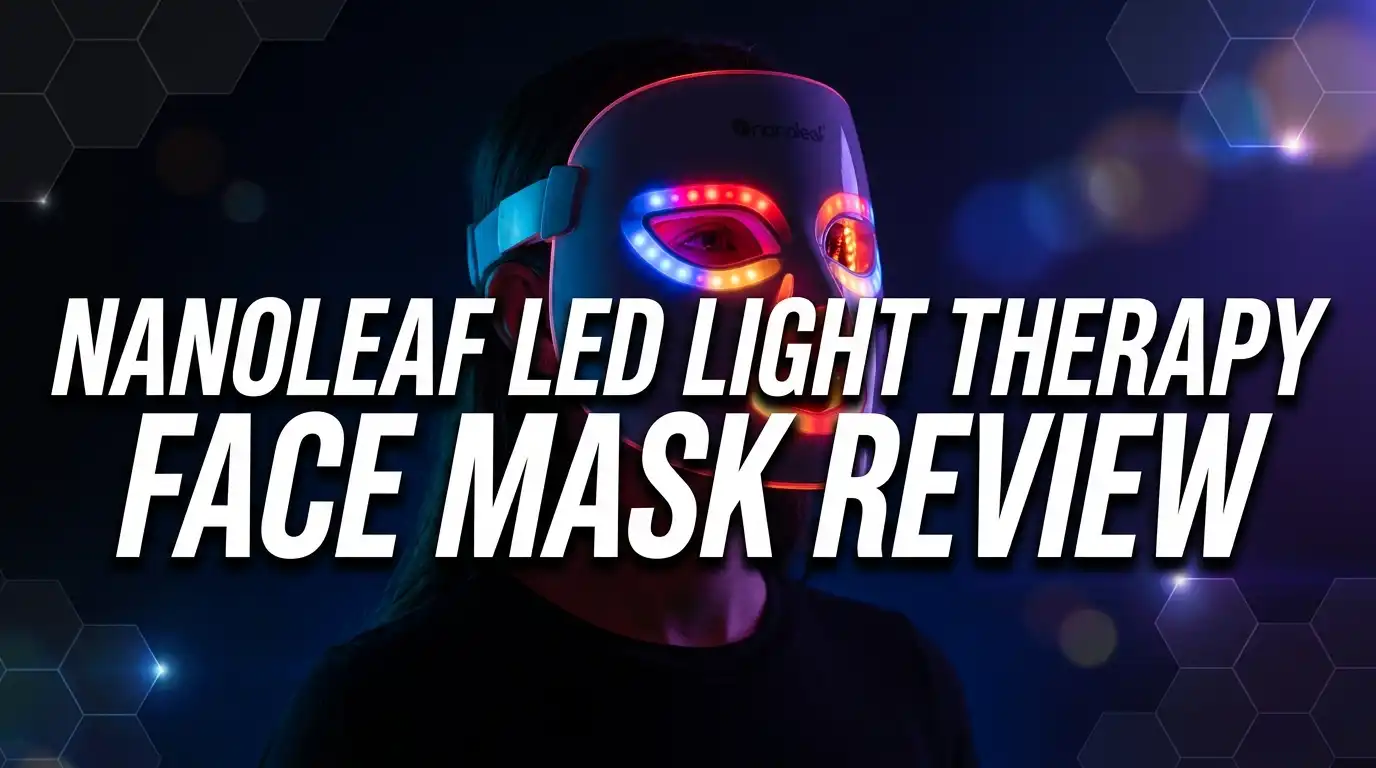
Nanoleaf built its name on glowing wall panels for gamers and design lovers. So the idea of strapping a Nanoleaf product to your face sounds a little strange at first. Yet here we are in 2026, and the Nanoleaf LED Light Therapy Face Mask has become one of the most talked about skincare devices under $300.
The results surprised me. This mask packs 432 diodes, four real wavelengths, and a therapeutic dose that matches devices costing twice as much.
But it is not flawless. The strap annoys me. The jawline coverage has gaps. And you cannot switch off the near infrared light even if you want to.
This review covers everything: the specs, the modes, the real world comfort, the price, and the alternatives worth your money. By the end, you will know if this mask belongs on your nightstand or not.
Key Takeaways
- The Nanoleaf LED Light Therapy Face Mask costs $249.99 and regularly drops closer to $200 during sales. That price buys you 432 medical grade diodes, which is an unusually high count for this bracket.
- Four real wavelengths do the work: roughly 639nm red, 848nm near infrared, 460nm blue, and 518nm green. The seven advertised modes come from blending these four diodes together.
- The dose is excellent. A standard 10 minute session delivers about 6.5 joules per square centimeter, which sits in the sweet spot for collagen support and skin renewal.
- Comfort is the weak point. The single Velcro strap sits low on the head and the mask slides slightly during longer sessions. Coverage also thins out around the chin, lips, and jawline.
- It is FDA cleared as a Class II device and carries a two year warranty plus a 30 day trial window, which removes most of the buying risk.
- Best for budget conscious beginners who want clinical strength light therapy without paying $400 or more. Perfectionists who want flawless fit should look elsewhere.
What Is the Nanoleaf LED Light Therapy Face Mask?

- 【FREE Strap Extender】 Contact us through Amazon to request one if a larger fit is required.
- 【7 Photobiomodulation Treatment Modes】 The Nanoleaf LED Light Therapy Mask delivers targeted light therapy across...
Last update on 2026-06-03 / Affiliate links / Images from Amazon Product Advertising API
The Nanoleaf LED Light Therapy Face Mask is a flexible silicone mask that sits on your face and shines specific light wavelengths into your skin. Nanoleaf launched it at CES 2025, where it picked up a Best of CES award.
The device uses a process called photobiomodulation. Light energy reaches the mitochondria in your skin cells. Those cells then produce more energy, which supports collagen production, faster repair, and calmer inflammation.
Nanoleaf built the mask with 108 LED clusters. Each cluster holds four separate diodes, one per wavelength. That adds up to 432 total light emitting diodes across the face.
The mask carries FDA Class II clearance. That means the US Food and Drug Administration reviewed the safety data and allowed Nanoleaf to sell it as a skincare device. It is also CE marked, FCC certified, and RoHS compliant.
You control everything through a small handheld remote with three buttons. Power, mode, and timer. The remote runs on its own battery and connects to the mask with a short cable.
Session length runs from 1 minute to 30 minutes. Nanoleaf recommends 5 to 10 minutes per treatment, three to five times each week.
The company positions this as an everyday wellness ritual rather than a medical treatment. You wear it while reading, listening to music, or winding down before bed. The silicone stays cool and does not trap heat, which makes longer sessions tolerable.
Design, Build Quality, and Comfort
The mask feels good in the hand. The silicone is soft, matte, and thick enough to hold its shape without feeling stiff. It weighs very little, so your neck never complains.
Two eye openings let you see clearly during a session. I could scroll my phone, read a book, or watch TV with the mask on. That sounds minor, but it changes how often you actually use the thing.
The strap is the problem. Nanoleaf uses a single Velcro band that fastens at the back of the head. It sits too low, which lets the mask creep downward during a session.
The band also presses against the back of your skull in a rigid way. It never hurt, but I noticed it every single time. A dual strap system, like the one on the Omnilux Contour, would fix this in one design revision.
Skin contact is generally strong across the forehead, cheeks, and temples. The flexible silicone hugs those curves well. Around the jaw, though, the mask lifts slightly away from the skin.
Heat is a nonissue. The mask never made me sweat, even during 15 minute sessions. Some rigid plastic masks turn into a sauna after five minutes, so this is a real advantage.
Build quality feels solid for the price. Nothing creaks, the cable port is reinforced, and the silicone wipes clean with a damp cloth.
Comfort verdict: good enough to use daily, but not the most comfortable mask on the market.
The 7 Light Therapy Modes Explained
Nanoleaf advertises seven modes. Here is what each one actually does and which ones deserve your attention.
Red light is the headline mode. It supports collagen, softens the look of fine lines, and improves overall radiance. This is the setting most people will use four or five nights a week.
Blue light targets breakouts. It reduces the bacteria linked to acne and calms oily, congested skin. Use it two or three times weekly if blemishes are your main concern.
Purple light is red and blue running together. It suits combination skin where you want texture support and blemish control in the same session.
Green light aims at pigmentation, dark spots, and uneven tone. Be honest with your expectations here, because the clinical evidence behind green light is thin compared to red.
Yellow light targets redness and puffiness. Many users report a calmer complexion after a few weeks, though again the research base is smaller.
Cyan light is marketed for irritated or sensitive skin. It is gentle and pleasant, but treat it as a bonus rather than a reason to buy.
White light plus near infrared is the deepest setting. It supports skin renewal and pairs well with your serums afterward.
Near infrared runs alongside every single mode. You cannot turn it off. For most people that is a benefit, since 850nm light reaches deeper tissue and boosts circulation.
My take: red, blue, purple, and white are the four modes worth your time. The rest are pleasant extras.
Top 3 Alternatives for Nanoleaf LED Light Therapy Face Mask
Not every face or budget suits the Nanoleaf. These three masks solve its biggest weaknesses.

- Enhanced collagen production capability significantly reduces fine lines, wrinkles and redness, for younger-looking...
- Upgraded light coverage provides our famous instant glow, for a healthier, brighter and smoother complexion.
Last update on 2026-08-24 / Affiliate links / Images from Amazon Product Advertising API

- Supercharged Face Care in 9 Minutes: A facial mask routine with 3 impressive LED light therapy technologies. Red light...
- Vibrating Facial Massager, Too: TheraFace LED mask delivers a 15-minute vibration therapy treatment to key pressure...
Last update on 2026-09-21 / Affiliate links / Images from Amazon Product Advertising API

- Better Aging Treatment: A 6-minute treatment utilizing Red & Infrared LEDs aimed at minimizing fine lines, and firming...
- Skin Clearing Treatment: Experience chemical-free acne-clearing with an 8-minute Blue & Infrared and Red LED session...

Last update on 2026-06-02 / Affiliate links / Images from Amazon Product Advertising API
The CurrentBody Skin LED Face Mask Series 2 is the accuracy pick. It uses 633nm red, 830nm near infrared, and 1072nm deep near infrared, all backed by published clinical data. The fit is excellent and the mask runs fully cordless. It costs more than the Nanoleaf, but the brand has the strongest research trail in the category.
The Therabody TheraFace Mask is the comfort upgrade. It adds vibration therapy, a fully wireless design, and better wavelength customization. It feels bulkier on the face, and the price sits well above $400, so it suits buyers who want extras beyond plain light therapy.
The Shark CryoGlow is the multitasker. It pairs red, blue, and deep infrared light with chilled under eye panels that target puffiness and dark circles. That cooling feature is genuinely unique and feels wonderful after a long day. It is heavier than the Nanoleaf and needs a separate power base.
Choose CurrentBody for clinical confidence, Therabody for comfort, and Shark for puffy morning eyes.
Wavelengths and Dosage: The Science Inside
Marketing language means nothing without numbers. Independent testing measured the Nanoleaf mask at four core wavelengths.
639nm red light handles surface level rejuvenation. It sits close to the 633nm standard used in most clinical studies.
848nm near infrared penetrates deeper. It supports circulation, collagen synthesis, and tissue repair below the visible surface.
460nm blue light works on the bacteria tied to acne. It also shows promise for mild eczema symptoms.
518nm green light rounds out the set. Evidence is limited, but it does no harm and some users like it for tone.
Dosage matters more than wavelength count, and this is where Nanoleaf shines. A 10 minute session delivers roughly 6.5 joules per square centimeter.
That number lands right in the therapeutic window. Too little energy does nothing. Too much can actually reverse the benefit, a phenomenon researchers call the biphasic dose response.
Nanoleaf tuned the output so a standard session hits the target without you doing any math. That is a genuinely smart engineering choice.
Compare this to the cheap $30 masks flooding online marketplaces. Many deliver under 1 joule per session, which is far too weak to trigger any cellular response.
Bottom line: the Nanoleaf gives you clinical grade dosing at a consumer price. That combination is rare.
Battery Life, Charging, and Controller
The mask runs on a rechargeable battery housed in the handheld controller. A full charge delivers around 80 minutes of use, which covers roughly eight to sixteen sessions depending on your settings.
Recharging takes about 3.5 hours over USB. I plug it in every Sunday and never think about it again during the week.
You cannot use the mask while it charges. Nanoleaf blocks this for safety reasons. Plan ahead if you run sessions every night.
The controller is compact, about the size of a car key fob. Three buttons handle everything: power, mode cycling, and timer adjustment.
By default the mask fires up in red plus near infrared mode with a 10 minute timer. That covers most users without touching anything else.
The screen is small. Really small. Reading the mode name in a dim bathroom takes a squint, and cycling through seven options with one button gets tedious.
The device is not fully cordless. A short cable links the mask to the controller. You can tuck the controller in a pocket or rest it on your chest, but the cable is always there.
Auto shutoff works reliably. The mask powers down when the timer ends, so falling asleep mid session is not a hazard.
The whole kit packs into a small pouch easily. Travel is simple, which is more than you can say for rigid masks with separate power bricks.
How to Use the Nanoleaf Face Mask Step by Step
Getting good results depends on doing this correctly. Here is the routine I follow.
Start with clean, dry skin. Wash your face and pat it dry. Light penetrates clean skin far better than skin coated in makeup or sunscreen.
Skip serums before the session. Some ingredients block light or become photosensitive under LED exposure. Retinol and certain acids are best applied afterward, not before.
Charge the controller fully. A dying battery dims the output and weakens your dose.
Position the mask over your face and fasten the strap. Take an extra five seconds to pull it snug near the temples, since that stops the downward slide.
Select your mode. Red plus near infrared works for most evenings. Switch to blue or purple on nights when breakouts appear.
Set the timer to 10 minutes. Longer is not better with light therapy.
Close your eyes or keep them relaxed. The light is bright and staring at the diodes serves no purpose.
Sit back, breathe, and let it run. I use the time for a podcast or a short meditation.
When the mask shuts off, wipe the silicone with a damp cloth. Then apply your moisturizer and any active serums.
Frequency matters most. Aim for three to five sessions each week. Most users notice visible change between weeks two and six, with continued improvement over several months.
My Results After Eight Weeks of Use
I used the mask five nights a week for eight weeks, mostly on red plus near infrared with two blue sessions weekly.
Weeks one and two brought nothing visible. This is normal. Light therapy works at the cellular level and needs time to show on the surface.
By week three I noticed my skin looked calmer in the morning. Redness around my nose faded, and the overall tone appeared more even.
Week five was the turning point. The fine lines at the outer corners of my eyes looked softer. Not gone, but noticeably less sharp under bathroom lighting.
Skin texture improved the most. My cheeks felt smoother and my pores appeared less prominent. Makeup sat better, which my partner noticed before I did.
The two blue light sessions each week reduced my jawline breakouts. Not eliminated, but the flare ups became smaller and healed faster.
What did not change: deeper forehead lines and old sun spots stayed exactly where they were. Light therapy is a maintenance and improvement tool, not an eraser.
I also slept better on nights I used the mask. That may be the routine rather than the light, but I will take it either way.
Eight weeks is a short window. Clinical studies on red light typically run twelve weeks or longer before measuring peak results. My guess is that another month would deliver further gains, and I plan to keep using it.
Pros and Cons of the Nanoleaf LED Light Therapy Face Mask
Here is the honest balance sheet after two months of testing.
Pros
- Four genuine wavelengths covering red, near infrared, blue, and green, which addresses aging, acne, and tone in one device.
- Perfect therapeutic dose of roughly 6.5 joules per square centimeter in a standard 10 minute session.
- 432 diodes give dense, even coverage across the forehead, cheeks, temples, and crow’s feet area.
- Flexible silicone body that contours to the face and never traps heat or causes sweating.
- Excellent price to performance ratio at $249.99, undercutting most premium competitors by $100 or more.
- FDA Class II clearance, CE marking, and a two year warranty provide real peace of mind.
- Eye openings let you read, scroll, or watch TV during treatment.
- Lightweight and packs into a small pouch for travel.
Cons
- The single Velcro strap sits too low and lets the mask slide during longer sessions.
- No option to switch off near infrared, which limits users with light sensitivity concerns.
- Weak coverage around the chin, jawline, and lips compared to competitors.
- The controller screen is tiny and awkward to read in dim rooms.
- Not fully cordless, since a cable links the mask to the handheld controller.
- You cannot operate the mask while it charges.
- Green, yellow, and cyan modes have limited clinical evidence behind them.
- Under eye coverage requires manual repositioning for the best exposure.
Nanoleaf vs CurrentBody vs Omnilux vs Shark
Choosing between the top masks comes down to priorities. Here is how the Nanoleaf stacks up.
Against CurrentBody Series 2: CurrentBody wins on clinical credibility and fit. It uses the research backed 633nm and 830nm wavelengths and runs fully cordless. The Nanoleaf wins on price and mode variety, offering blue and green light that CurrentBody skips.
Against Omnilux Contour Face: Omnilux is the dermatologist favorite and holds FDA clearance specifically for treating fine lines and wrinkles. Its dual strap fit is far better. But Omnilux only gives you red and near infrared, and it costs more. If acne is part of your concern, Nanoleaf is the more flexible tool.
Against Shark CryoGlow: Shark adds cooling under eye panels and a strong clinical testing program. It is heavier and needs a base unit. Nanoleaf is cheaper, lighter, and easier to travel with.
Against budget marketplace masks: this is not close. Most sub $100 masks deliver a fraction of the energy needed to do anything. Nanoleaf delivers real clinical dosing.
One independent reviewer scored the Nanoleaf 77.5 out of 100, the highest score in his entire mask testing database at the time. That ranking came largely from the price to performance balance rather than raw comfort.
Summary: Nanoleaf is the value champion. Omnilux and CurrentBody are the accuracy champions. Shark is the feature champion.
Price, Warranty, and Value in 2026
The mask retails at $249.99 on the Nanoleaf site and on Amazon. Sale periods pull it toward $200, and bundle deals with the LED wand or neck mask appear regularly.
That price positions it squarely in the middle of the market. Cheap marketplace masks sit under $100 and deliver almost nothing. Premium masks from Omnilux, Dr Dennis Gross, and Therabody run from $400 to $600.
Nanoleaf gives you roughly 90 percent of premium performance for around half the price. That is the core argument for buying it.
The warranty covers two years in most regions, with coverage length varying by country. Nanoleaf replaces defective units at no charge under normal use.
A 30 day return window applies to direct purchases. There is a small restocking fee on returns, but the amount is minor.
Running costs are effectively zero. No replacement bulbs, no consumables, no subscription. You recharge it over USB and wipe it clean.
Compare that to a single professional LED facial, which typically costs $75 to $150 per session. Three or four clinic visits equal the full price of this mask.
The value case gets stronger if more than one person in your household uses it. Wipe the silicone between users and it works fine as a shared device.
Verdict on value: among the strongest in the category right now.
Who Should Buy It and Who Should Skip It
Buy the Nanoleaf mask if you are new to light therapy. The preset modes and default 10 minute timer remove all guesswork.
Buy it if you want more than red light. The blue and purple modes make it genuinely useful for acne prone skin, which pure red masks cannot match.
Buy it if your budget caps around $250. Nothing else at this price delivers this combination of diode count and dose accuracy.
Buy it if you travel often. The flexible silicone folds, the controller is tiny, and the whole kit fits in a carry on pocket.
Skip it if comfort is your top priority. The low strap and slight slide will irritate anyone sensitive to fit issues.
Skip it if your main concern is jawline or chin aging. Coverage in that zone is genuinely weaker than on competing masks.
Skip it if you need near infrared switched off. Certain medications and skin conditions increase light sensitivity, and this mask offers no way to disable NIR.
Skip it if you expect dramatic results in two weeks. Light therapy is slow, cumulative, and requires consistency.
Anyone with lupus, active skin cancer, epilepsy triggered by light, or a course of photosensitizing medication should talk to a doctor before use. This advice is general information, not medical guidance, so check with your own healthcare provider.
Final Verdict: Is the Nanoleaf Mask Worth It in 2026?
Yes, for most buyers, the Nanoleaf LED Light Therapy Face Mask is worth the money.
- 【FREE Strap Extender】 Contact us through Amazon to request one if a larger fit is required.
- 【7 Photobiomodulation Treatment Modes】 The Nanoleaf LED Light Therapy Mask delivers targeted light therapy across...
Last update on 2026-06-03 / Affiliate links / Images from Amazon Product Advertising API
Nanoleaf entered a crowded category from an unexpected direction and built something genuinely competitive. The diode count is high, the dose is accurate, and the price undercuts almost every serious rival.
The skin benefits are real. Over eight weeks I saw smoother texture, calmer redness, and softer fine lines. Those are the exact outcomes the research predicts from consistent red and near infrared exposure.
The flaws are real too. The strap needs a redesign, the chin coverage needs more diodes, and the controller screen needs to be bigger.
None of those flaws stop the mask from working. They just stop it from being perfect.
If you want the best possible fit and the deepest clinical backing, spend the extra money on Omnilux or CurrentBody. If you want the most skin benefit per dollar, this is the mask to buy.
I would recommend it to a friend without hesitation, with one caveat: buy during a sale if you can, and give it the full eight to twelve weeks before you judge the results.
Final score: a strong buy for beginners and budget focused users, and a reasonable second device for enthusiasts.
Frequently Asked Questions
How often should I use the Nanoleaf LED face mask?
Use it three to five times each week for 5 to 10 minutes per session. Daily use is safe but offers no extra benefit. Consistency over several weeks matters far more than session length.
When will I see results from the Nanoleaf face mask?
Most users notice visible change between weeks two and six. Texture and redness improve first. Fine lines soften later, usually around weeks six to twelve.
Is the Nanoleaf LED Light Therapy Face Mask FDA cleared?
Yes. It holds FDA Class II device clearance, which means the agency reviewed its safety data before it reached the market. It also carries CE marking and FCC certification.
Does the mask hurt or feel hot?
No. Light therapy is painless. Most users feel gentle warmth or nothing at all. The silicone does not trap heat, so sweating is rare.
Can I wear the mask with skincare products on?
Start with clean, dry skin. Apply serums and moisturizer after the session ends, not before. Some ingredients block light or react badly under LED exposure.
Can I use the mask while it charges?
No. Nanoleaf blocks operation during charging for safety. Charge the controller fully before your session. A full charge gives about 80 minutes of use.
Is the Nanoleaf mask safe for sensitive skin?
Many users with sensitive skin tolerate it well. Start with shorter sessions at lower intensity. Consult a doctor first if you take photosensitizing medication or have a diagnosed skin condition.
Do I need eye protection with this mask?
The mask has open eye areas, so no goggles are required. Avoid staring directly into the diodes. Keeping your eyes closed or relaxed during a session is the simplest approach.
How does Nanoleaf compare to CurrentBody?
CurrentBody offers better fit and stronger clinical research. Nanoleaf offers more modes, more diodes, and a lower price. Both deliver real results with consistent use.
Can two people share one mask?
Yes. Wipe the silicone surface with a soft damp cloth between users. Never submerge the mask in water or use harsh cleaning chemicals on it.